Hyperspectral Operating Environment

The hyperspectral operating environment is an interdisciplinary crosslink between stakeholders like scientists, application engineers and instrument providers.

As a consequence stakeholders of hyperspectral imaging have a general platform to interact with each others and to share encapsulated know-how.

For example, a camera manufacturer or machine builder offer its own classification plugin which works exclusively with its own hardware. On the other hand side scientists encapsulate their algorithms and provide them to industrial partners.


Hyperspectral Operating Environment, hyperspectral technology, hyperspectral

In computer software, an operating environment is the environment in which users run application software. The environment consists of a user interface provided by an applications manager and usually an application programming interface (API) to the applications manager. An operating environment is usually not a full operating system but is a form of middleware that rests between the OS and the application. For example, the first version of Microsoft Windows, Windows 1.0, was not a full operating system, but a GUI laid over DOS albeit with an API of its own.

Deploying hyperspectral technology nowadays is tricky and time-consuming. Especially the cooperation of involved experts of different disciplines is limited due to a missing common base. Perception Park has started to develop a layer between the operating system and the end-application, enabling the first operating environment for hyperspectral technology.


Hyperspectral Operating Environment, hyperspectral technology, hyperspectral

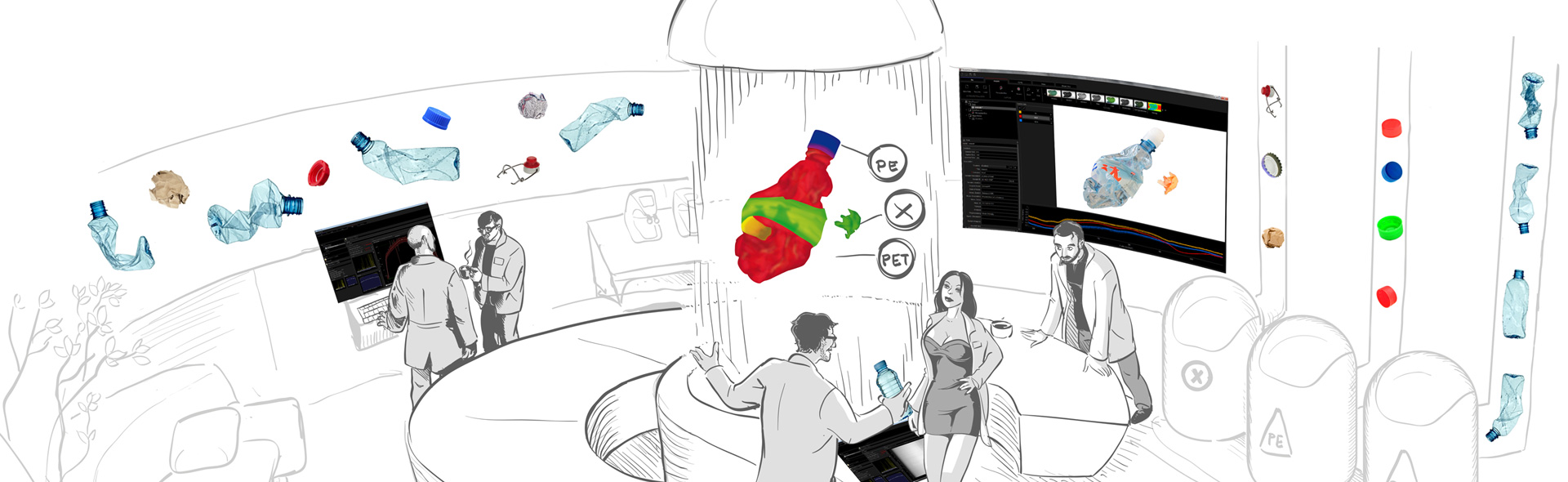
The figure above shows typical shareholders of the hyperspectral community. Here the operating environment allows an interdisciplinary cross-linking.


Hyperspectral Operating Environment, hyperspectral technology, hyperspectral


The layer model above shows the operating system, operating environment and the application layer.

The provided plug-in framework architecture allows the community to extend functionality on their own. This results in a common base expandable by experts and customizable by end-users. Such concepts are known from web browsers (add-ons) or mobile devices (app store). Since the operating environment supports real-time processing as well as the integration of hardware and/or software as plug-in, all necessities for new concepts of application are fulfilled.


Hyperspectral Operating Environment, hyperspectral technology, hyperspectral

The image above summarizes important components of the operating environment.


The Mechanism of Perception Studio


As shown in the figure, the Perception Studio provides core functionality such as “Plug-in Manager” for loading plug-ins, managing dependencies or version management. Further helpful functionality like our encryption based on AES, our project browser that manages all files generated by plug-ins and a predefined help system are integrated into the Perception Studio. All of this functionality can be used by all plug-ins including a way for plug-ins to register themselves with the Perception Studio and a protocol for the exchange of data with other plug-ins.

Perception Park, Perception Studio, Operating Environment, Plug in, chemical imaging, chemical color imaging, chemical colour imaging, CIT, Chemical Imaging Technology, quality assurance, PAT, QbD, sorting, food processing, mining, recycling, industrial image processing, image processing, bildverarbeitung, industrielle bildverarbeitung, hyperspectral imaging, spectral imaging, pharma, plastic sorting, pharmaceutical, Verlese Maschine, optical sorting, camera

Plug-ins depend on the services provided by the Perception Studio and usually do not work by themselves. Conversely, the Perception Studio operates independently of the plug-ins, making it possible for end-users to add and update plug-ins dynamically without the need to make changes to the core program (Perception Studio).

A plug-in itself is simply a *.dll-File to be installed and is an extension to the core functionality of Perception Studio. Therefore Perception Studio provides various Extension Points where plug-ins can be integrated. This extension points are open for all developers and a SDK (Software Development Kit) is available.

The Perception Studio initializes the plugin system, decides what capabilities plugins can use and then proceed with its ordinary tasks.

Several plugins are provided which can be used with the Perception Studio and also with any other plug-in (if the plug-in allows them). For developing plug-ins, an SDK (Software Development Kit) is provided.


Extension Point for Hardware

Perception Park, Perception Studio, Operating Environment, Plug in, chemical imaging, chemical color imaging, chemical colour imaging, CIT, Chemical Imaging Technology, quality assurance, PAT, QbD, sorting, food processing, mining, recycling, industrial image processing, image processing, bildverarbeitung, industrielle bildverarbeitung, hyperspectral imaging, spectral imaging, pharma, plastic sorting, pharmaceutical, Verlese Maschine, optical sorting, camera

The extension point for hardware is an interface for the communication with hardware components and allows the implementation of hardware devices like different cameras. There are no limitations which hardware can be integrated.

Consequently beside standard push-broom imagers also other sensors for staring imaging, whisk-broom imaging or snapshot imaging can be integrated. Further hardware like traversing tables, sampling devices or even acoustic cameras can be implemented too.

By this multi-camera-systems can easily be set up and controlled by one single software solution.


Extension Point for File Formats

Perception Park, Perception Studio, Operating Environment, Plug in, chemical imaging, chemical color imaging, chemical colour imaging, CIT, Chemical Imaging Technology, quality assurance, PAT, QbD, sorting, food processing, mining, recycling, industrial image processing, image processing, bildverarbeitung, industrielle bildverarbeitung, hyperspectral imaging, spectral imaging, pharma, plastic sorting, pharmaceutical, Verlese Maschine, optical sorting, camera

The extension point for file formats allows the implementation of all needed file formats such as configuration files for hardware. It also supports a plug-in to save and convert data in various file formats.

This is commonly used by users that have a proprietary file format. Furthermore this interface is a possibility to use Perception Studio methodology with data from third party applications.


Extensionpoint for User Interface

Perception Park, Perception Studio, Operating Environment, Plug in, chemical imaging, chemical color imaging, chemical colour imaging, CIT, Chemical Imaging Technology, quality assurance, PAT, QbD, sorting, food processing, mining, recycling, industrial image processing, image processing, bildverarbeitung, industrielle bildverarbeitung, hyperspectral imaging, spectral imaging, pharma, plastic sorting, pharmaceutical, Verlese Maschine, optical sorting, camera

The extension point for the user interface provides the possibility to design perspectives, wizards or editors which are specialized to a dedicated application. This is often necessary to make a whole workflow accessible and easy to use.

It is quite easy to access the user interface extension point due that the Perception Studio is based on the Qt Project. Qt is a cross-platform application and UI framework for developers using C++ or QML, a CSS & JavaScript like language.


Extension Point for Algorithms

Perception Park, Perception Studio, Operating Environment, Plug in, chemical imaging, chemical color imaging, chemical colour imaging, CIT, Chemical Imaging Technology, quality assurance, PAT, QbD, sorting, food processing, mining, recycling, industrial image processing, image processing, bildverarbeitung, industrielle bildverarbeitung, hyperspectral imaging, spectral imaging, pharma, plastic sorting, pharmaceutical, Verlese Maschine, optical sorting, camera

Developers of algorithms for applications based on spatially resolved and multidimensional data (e.g. hyperspectral data) can bring their methodology into the Perception Studio by accessing the extension point for algorithms. Developers can implement their algorithms without worrying that their plug-ins could be reengineered.

Especially research organizations appreciate this functionality because they just need to develop methodology for their customers and can use the framework and basic functionality of Perception Studio to shorten time to market and to keep their own software solution extendable.

+ -